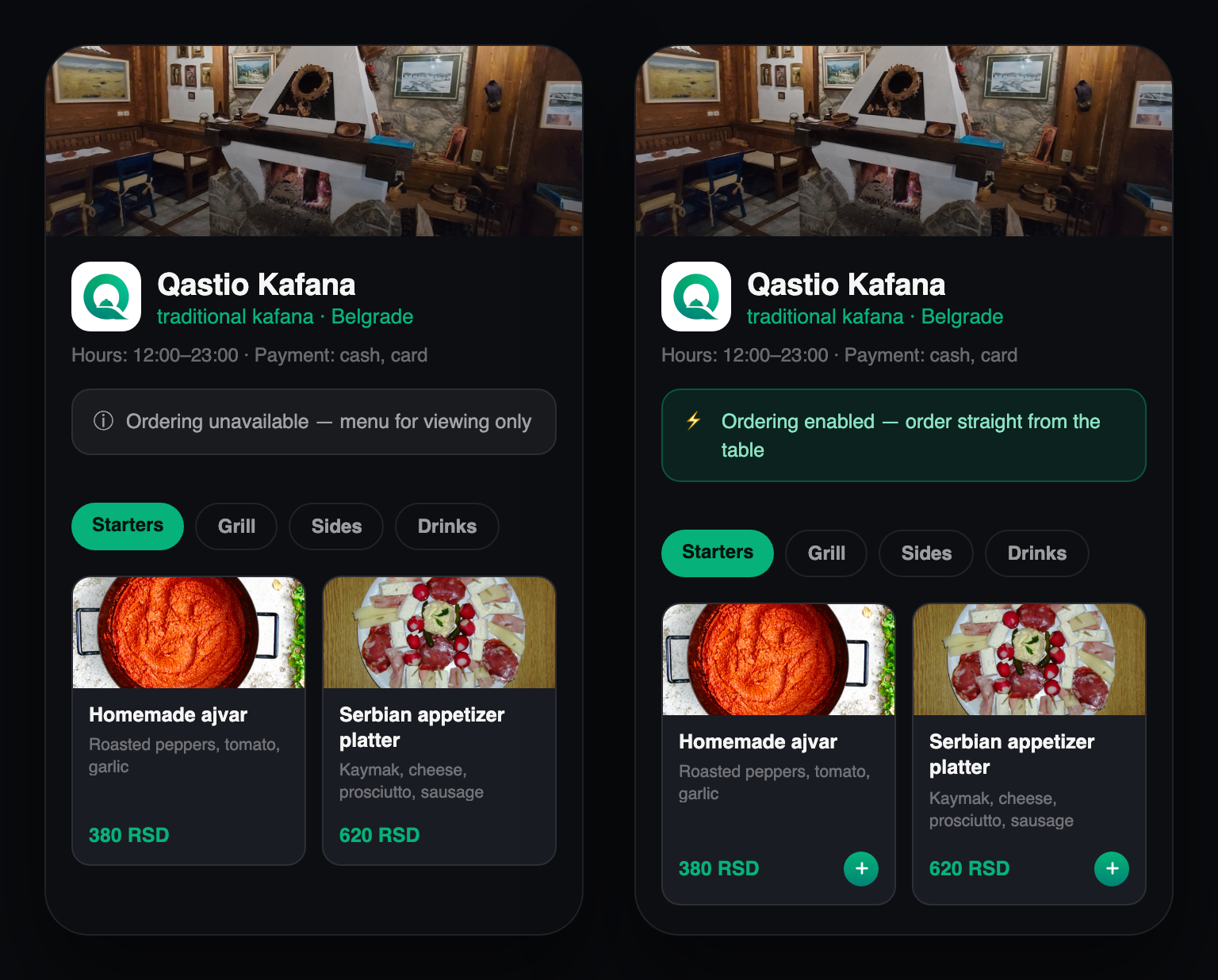
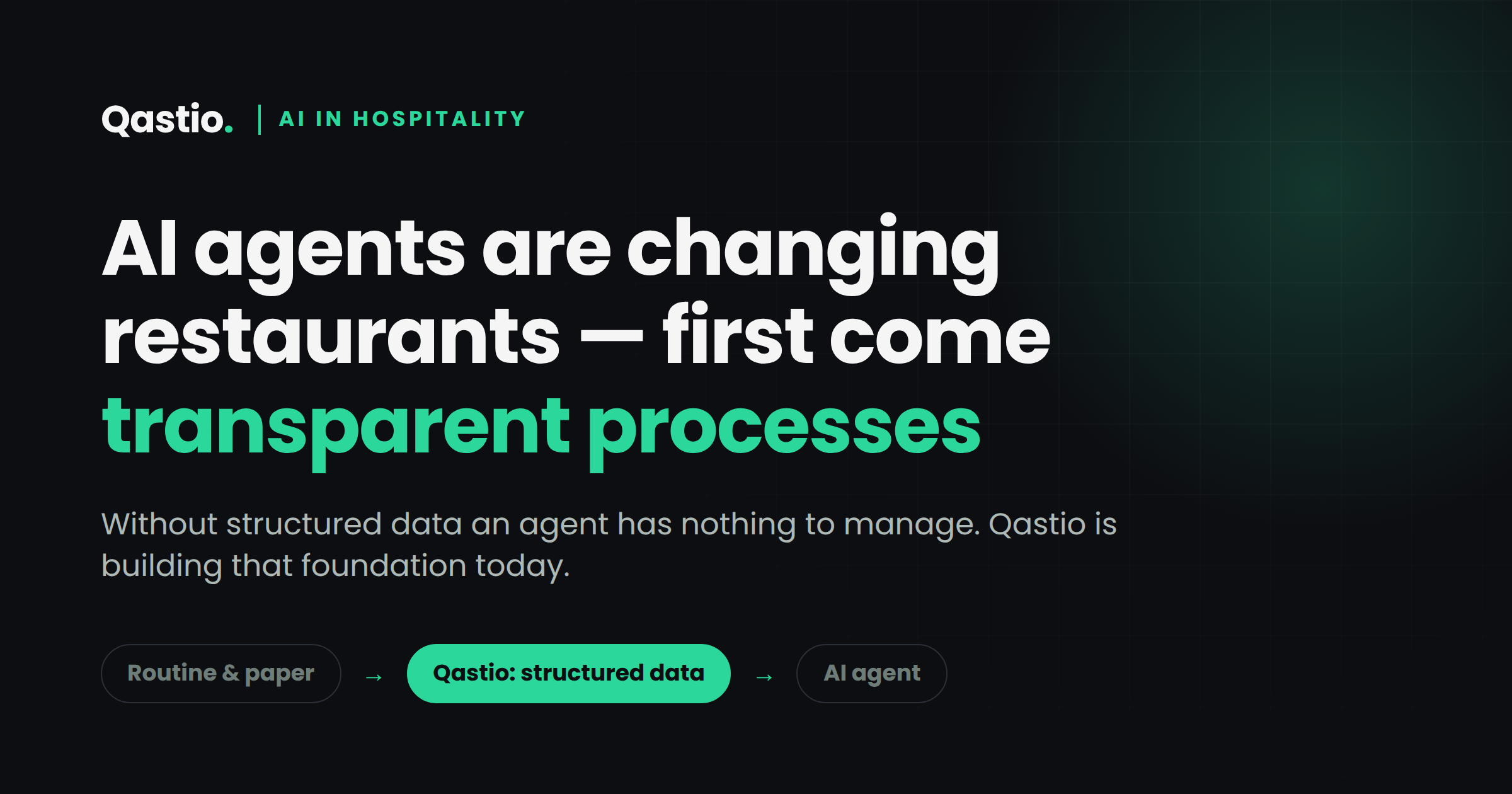
AI agents in restaurants are tools that take on routine and administrative work — from demand forecasting to food-cost control — but they only function on top of transparent, digitized processes. Without structured data on orders, reservations and sales, an agent has nothing to manage. Qastio already turns that everyday routine into a digital form — QR ordering, reservations, analytics, allergens, a multilingual menu — and in doing so builds the foundation on which automation becomes real rather than a slogan.
AI in hospitality: what AI agents are — and what the industry is only now naming
An AI agent differs from ordinary AI in that it doesn't just answer questions — it independently carries out tasks, makes recommendations and communicates with other business systems. In hospitality the scenarios most often cited are procurement and inventory, demand forecasting, food-cost control, personalized marketing and management analytics.
All of these share one condition: the agent needs structured data at the input. Demand forecasting needs a history of sales. Recommending a dish to a guest needs a structured menu and an order history. A management report needs data that has already been aggregated somewhere — not scattered across waiters' heads and paper checks. That is where the key decision is made: before you bring in an agent, you need a process that produces data.
"The waiter is not a cash register": an idea Qastio held before the term went mainstream
Qastio never positions itself as a replacement for waiters. The correct framing is the opposite: removing routine — punching orders into the POS, running to the terminal, splitting the bill — so the waiter has more time for the guest. That is the same stance the trade press now attributes to AI agents: they do not replace employees but rather assume routine and administrative work (CaféBar & Restoran, August 2026). Qastio held that idea earlier, only applied to concrete, live features.
Each of these features removes routine and turns a process into data at the same time:
- QR ordering — the guest orders directly, without waiting for a waiter; the "walk over / take the order / carry it to the till" step disappears, and instead of a paper ticket a structured order record is created immediately.
- Table reservation — no phone calls or manual seating; occupancy is tracked in one place.
- Allergens in the menu — repeated follow-up questions from guests disappear, and the menu is already structured as data, not a PDF or paper.
- Restaurant analytics — no manual assembly of sales and best-seller reports; what used to live only in the manager's head is aggregated.
- Multilingual menu — the language barrier falls without the waiter acting as translator.
Why automation without transparent processes stays a fantasy
An agent that "independently carries out tasks and communicates with other systems" physically cannot work without input data. So the first real step toward restaurant AI automation is not a chatbot layered over chaos, but translating operations into a structured digital form. That is not a storefront — it is infrastructure.
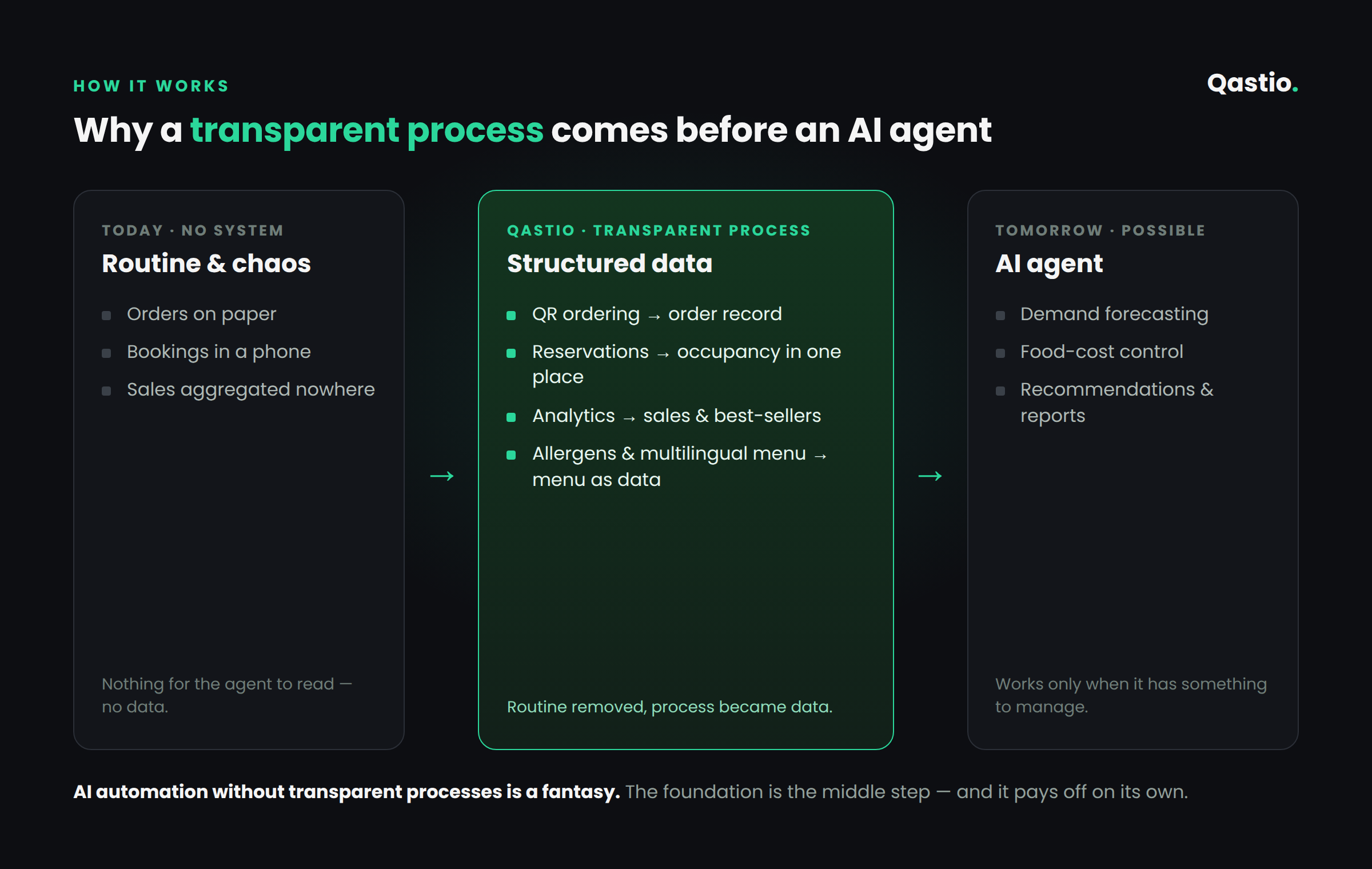
A restaurant that wants real automation, not an "we have AI" sign, first goes through a phase of transparent digital processes: transparent ordering, transparent occupancy, transparent analytics. Qastio covers exactly that phase — not claiming to already ship AI agents, but taking the position of the infrastructure foundation. That is precisely what, by the industry's own definition, the AI-agent conversation stays a fantasy without. The fact that this base is being built now naturally raises the "what's next" question — but specific features are not promised here until they exist in the product.
What this concretely means for a venue owner
You don't have to wait for "full AI agents" to benefit today. Removing routine and digitizing processes pay off on their own — they are not an empty preparatory step. And when agents become practical for wider use, a venue that has already digitized orders, reservations and analytics starts from a foundation, while one with paper tickets starts from zero.
Qastio is also modular: not an "all or nothing" package but a construction kit — you plug in only the modules you need, step by step. Moving to transparent processes doesn't have to be one big decision; it can start with a single table and a single QR code. Venues already running on Qastio are listed in the restaurant catalog.